
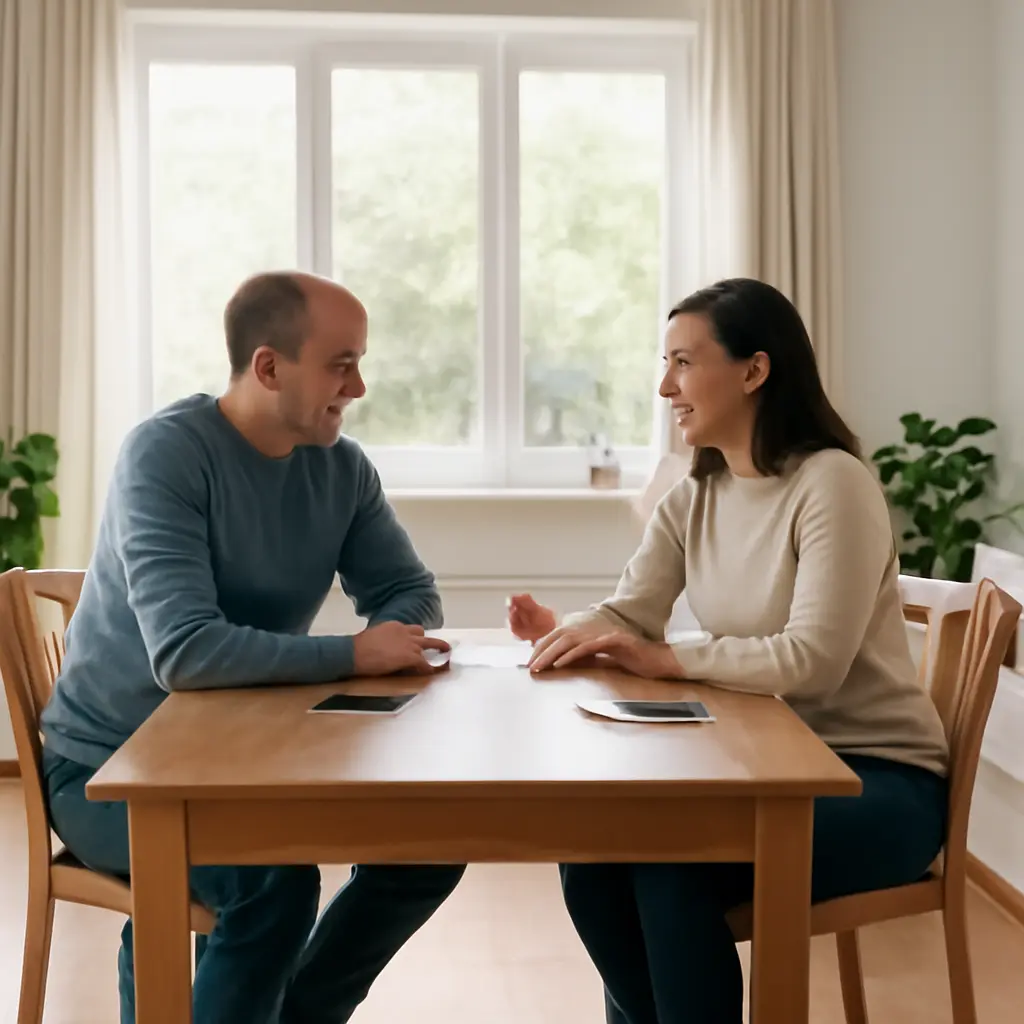
Couples who intentionally set aside phones and other digital distractions may find it easier to protect bedtime routines and give one another more focused attention. “Disconnecting” is not a guaranteed treatment for poor sleep or relationship conflict, and the research does not prove that a phone-free evening automatically creates deeper conversations. But studies link bedtime device use with disrupted sleep, while relationship research suggests that attentive, responsive listening supports closeness. Together, those findings make a practical case for couples to try modest, shared boundaries around screens—without treating a small evidence base as proof of a universal effect.
Digital disconnection and couples’ sleep and conversation quality
Digital disconnection means deliberately pausing or limiting optional screen use, especially during shared time and the period before sleep. It can include silencing notifications, charging phones outside the bedroom, or agreeing to a short screen-free conversation. The potential benefits matter because sleep is essential to health and daily functioning, while feeling heard and understood is central to relationship satisfaction. The evidence is strongest for associations between nighttime technology use and sleep problems; evidence specifically testing couples’ shared “digital detox” routines is more limited.
How digital boundaries relate to couples’ sleep and connection
There is no single clinical definition of a couple’s digital-disconnection routine. In practice, it is a mutually agreed boundary that reduces nonessential device use at particular times or in particular places. The American Academy of Sleep Medicine recommends adults regularly obtain at least seven hours of sleep, and its sleep guidance encourages people to establish a relaxing routine and limit technology before bed. These recommendations support trying a calmer, less device-centered bedtime, but they do not establish that every couple will sleep better after putting phones away.
The distinction between evidence types is important. Laboratory studies, surveys, and reviews have examined screen exposure, bedtime phone use, and sleep outcomes; relationship studies have examined perceived responsiveness, listening, and satisfaction. Findings from those separate areas offer plausible reasons to experiment with shared boundaries, but they are not the same as a controlled trial proving that couples who disconnect have better sleep and deeper conversations.
Bedtime device use and sleep disruption
Bedtime device use refers to using a phone, tablet, computer, or television close to or during the intended sleep period. It may affect sleep by delaying bedtime, prompting alerts or interactions, or keeping the mind engaged. A systematic review and meta-analysis published in JAMA Pediatrics in 2016 found that bedtime access to or use of portable screen devices among children and adolescents was associated with inadequate sleep, poor sleep quality, and daytime sleepiness. Because the review concerned young people, its results should not be presented as direct proof about adult couples; they do, however, illustrate how nighttime device habits can overlap with sleep outcomes.
For adults, the National Sleep Foundation and sleep-medicine guidance commonly advise a consistent wind-down routine and reducing stimulating activities before bed. Couples can test a practical version: agree on a time to stop optional scrolling, keep urgent-call exceptions, and move charging devices away from the bed. A simple chart could track bedtime, estimated time to fall asleep, nighttime awakenings, and morning restedness for two weeks before and after the change. Such a personal comparison can help identify patterns, though it is not a substitute for a clinical sleep assessment.
Phubbing and perceived partner responsiveness
“Phubbing,” a blend of “phone” and “snubbing,” describes attending to a phone instead of a person who is physically present. Research has examined how perceived partner phubbing relates to relationship satisfaction and conflict. A 2016 study by James A. Roberts and Meredith E. David in the journal Computers in Human Behavior reported associations between partner phubbing, conflict over mobile-phone use, and relationship satisfaction in its surveyed participants. These findings are correlational: they do not show that phone use alone causes relationship problems, and they cannot establish that putting phones away will resolve them.
A useful bridge from reduced phubbing to better conversation is attention. In research on close relationships, Harry T. Reis and colleagues describe perceived partner responsiveness as feeling understood, validated, and cared for. A screen-free interval may make it easier to communicate those qualities by reducing interruptions, but the quality of the interaction still depends on listening, respect, and emotional safety—not merely on the absence of a device.
Focused conversation and active listening
Active listening is a communication practice in which a person gives attention, checks understanding, and responds to what a partner has said rather than immediately shifting to advice or rebuttal. A 2018 review by Harry T. Reis and colleagues in Current Opinion in Psychology discusses responsiveness as a core process through which partners build intimacy. A phone-free conversation can create the conditions for attentive listening, but it does not guarantee intimacy: partners may still need to ask open questions, reflect back what they heard, and make room for disagreement.
For example, a couple might set aside 15 minutes after dinner with phones silenced and ask, “What took the most energy today?” One partner listens without multitasking, then summarizes the answer before sharing their own. This is a practical exercise, not a clinical intervention or a result established by a specific trial. If conversations repeatedly become hostile or unsafe, professional support may be more appropriate than relying on a screen-free routine alone.
Ways couples can try a shared digital-disconnection routine
A workable boundary is specific, mutual, and flexible. Couples can start with one predictable period rather than imposing a sweeping ban, then assess whether it helps their sleep, attention, or sense of connection. Shared agreements should account for caregiving, work responsibilities, accessibility needs, and emergencies.
- Choose a realistic window, such as the final 30 minutes before bed or the first part of a shared meal.
- Silence nonurgent notifications and agree on how urgent calls will get through.
- Keep a charger outside the bedroom if that is practical, while preserving access to medical or safety devices when needed.
- Replace scrolling with a calming activity, such as reading, stretching, or a brief conversation.
- Review the routine after one or two weeks and adjust it without blaming either partner.
These steps are best treated as a low-cost experiment, not a guaranteed remedy. People with persistent insomnia, loud snoring, breathing pauses during sleep, or significant daytime impairment should seek advice from a qualified health professional. Couples experiencing serious or recurring relationship distress may also benefit from a licensed therapist.
Conclusion: shared boundaries can support rest and attention
Digital disconnection offers couples a practical way to protect bedtime routines and give conversations more undivided attention. Sleep research links nighttime device access or use with poorer outcomes in some populations, while relationship research connects responsiveness and feeling understood with intimacy. Those findings support trying clear, mutually agreed screen boundaries, but they do not prove that disconnection alone causes better sleep or deeper conversations for every couple. Start small, track what changes, and seek professional guidance when sleep or relationship difficulties persist.
Sources: Watson, Nathaniel F., et al., “Recommended Amount of Sleep for a Healthy Adult: A Joint Consensus Recommendation of the American Academy of Sleep Medicine and Sleep Research Society,” Sleep, 2015, https://academic.oup.com/sleep/article/38/6/843/2416939; Carter, Ben, et al., “Association Between Portable Screen-Based Media Device Access or Use and Sleep Outcomes: A Systematic Review and Meta-analysis,” JAMA Pediatrics, 2016, https://jamanetwork.com/journals/jamapediatrics/fullarticle/2571467; Roberts, James A., and Meredith E. David, “My Life Has Become a Major Distraction from My Cell Phone: Partner Phubbing and Relationship Satisfaction Among Romantic Partners,” Computers in Human Behavior, 2016, https://doi.org/10.1016/j.chb.2015.07.058; Reis, Harry T., et al., “Perceived Partner Responsiveness as an Organizing Construct in the Study of Intimacy and Relationship Processes,” Current Opinion in Psychology, 2018, https://doi.org/10.1016/j.copsyc.2017.05.016; American Academy of Sleep Medicine, “Healthy Sleep Habits,” https://sleepeducation.org/healthy-sleep/healthy-sleep-habits/.