
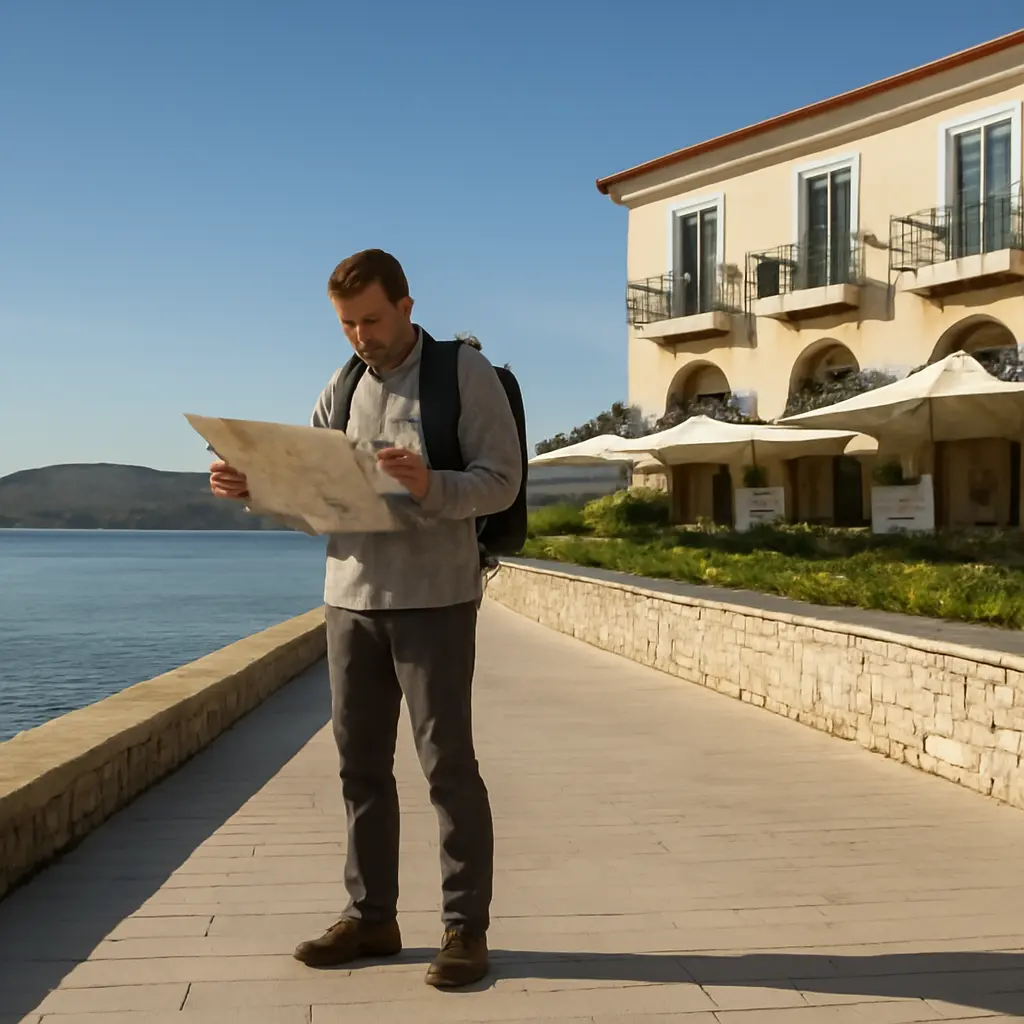
A scenic hotel location is more than a pleasing view: it is the hotel’s position in relation to natural and cultural landmarks, transport, local communities, and the experiences travelers came to have. Travelers often focus on room photos and overlook how location shapes the whole stay—from what they can reach on foot to when the best light hits a mountain or waterfront. Research on travel behavior, walkability, and tourism shows why the setting can influence satisfaction, time use, and spending. Understanding the difference between a beautiful view and a genuinely useful location helps travelers choose stays that deliver both scenery and access.
Scenic hotel locations combine landscape, access, and experience
A scenic hotel location can be defined as a lodging setting whose surrounding landscape or built environment contributes meaningfully to the guest experience. The United Nations World Tourism Organization describes tourism as travel outside a person’s usual environment, while the setting of a hotel determines how readily guests experience the destination’s distinctive features. In practical terms, the strongest locations balance visual appeal with access, comfort, and a sense of place.
The distinction matters because a spectacular panorama may come with long transfer times, limited dining choices, or difficult terrain. Conversely, a hotel in a walkable historic district may offer less dramatic scenery from the window but place guests within minutes of landmarks, food, and transit. The location’s real value is therefore measured not only by what guests see, but also by what they can do from there.
Natural scenery: coastlines, mountains, lakes, and countryside
Natural scenic locations are hotels positioned near landscapes such as beaches, forests, lakes, deserts, or mountain ranges. Their advantages include immediate access to outdoor activities and changing views across weather, seasons, and daylight. But proximity should be checked carefully: “near the beach” may mean a short walk, a steep trail, or a drive, and a mountain view may be visible only from selected rooms.
Travelers should assess practical conditions alongside the image: shoreline access, trail difficulty, seasonal closures, wildfire or flood exposure, and whether the view is obstructed by nearby buildings. A hotel’s location can support a lower-impact trip when it reduces car journeys, but only if essential services and activities are actually reachable without driving.
Cultural and urban scenery: heritage districts and waterfronts
Cultural scenic locations place a hotel among recognizable architecture, public spaces, historic streets, or active waterfronts. These settings offer a form of scenery shaped by people and history rather than nature alone. UNESCO’s World Heritage framework emphasizes the cultural and natural significance of places; for visitors, staying near such places can make early-morning walks, evening visits, and unplanned exploration easier.
The trade-off is that popular districts may bring noise, crowds, higher prices, or restrictions on vehicle access. A hotel beside a landmark is not automatically the best base if guests must cross congested roads or rely on costly transfers. Checking walking routes and transit connections turns proximity from a marketing claim into a usable benefit.
Scenic hotel locations shape access and daily travel
Location functions as travel infrastructure: it determines the time, cost, and effort required to reach attractions and services. The U.S. Environmental Protection Agency’s Smart Location Database uses measures such as street connectivity, density, and access to destinations to describe how places support walking and transit. Those measures help explain why a hotel’s address can be as consequential as its amenities.
Walkability and proximity
Walkability means that useful destinations can be reached safely and conveniently on foot. A scenic hotel near restaurants, viewpoints, trails, and transit may allow guests to spend more time experiencing a destination and less time arranging transport. Travelers can test this by checking actual walking routes, elevation changes, sidewalks, crossings, and opening hours rather than relying solely on straight-line distance.
The Centers for Disease Control and Prevention’s walkability resources connect pedestrian-friendly environments with opportunities for physical activity. That does not mean every traveler should walk everywhere: weather, mobility, luggage, and road conditions matter. The useful question is whether the hotel gives guests realistic choices rather than forcing them into a car or taxi for every outing.
Transit access and travel time
Transit access is the ease of reaching public transport from the hotel and using it to visit key places. For a scenic property outside a city center, the nearest bus, rail, ferry, or shuttle stop can determine whether the location feels secluded or inconvenient. Compare door-to-door journey times, service frequency, last departures, and the cost of transfers—not just the distance to a station.
The U.S. National Travel and Tourism Office tracks international visitor activity and travel patterns, underscoring that trips involve movement between gateways, accommodation, and attractions. For individual planning, a simple route comparison can reveal whether a seemingly remote hotel saves time through a direct shuttle or adds substantial daily travel.
Scenic hotel locations influence satisfaction and value
A scenic setting contributes value when it improves the stay in ways guests care about: memorable views, convenient activities, restful surroundings, or meaningful contact with local culture. The value is not identical for every traveler. A couple seeking a quiet retreat may prize seclusion, while a family may prioritize nearby food, safe paths, and reliable transport.
Views, room orientation, and seasonality
A hotel’s general location does not guarantee that every room has the advertised view. Room orientation, floor level, vegetation, neighboring construction, and weather all affect what guests can see. Before booking, verify whether a view is guaranteed, whether it carries a surcharge, and whether photographs show a specific room category or a shared terrace.
Seasonality changes both scenery and access. Alpine trails may be snowbound, coastal paths may be exposed to storms, and foliage or daylight varies across the year. National Park Service guidance routinely advises visitors to check current conditions and closures before travel; the same habit is useful when choosing any nature-oriented hotel.
Local experience and community connection
A location can make local experience more accessible by placing guests near independent businesses, markets, cultural institutions, and public spaces. This benefits travelers seeking a stronger sense of place and can direct spending toward local operators. The OECD’s tourism analysis highlights tourism’s economic effects on destinations, while also noting the importance of managing those effects responsibly.
Guests can look for signs of responsible location planning: clear information about local transport, respect for residential quiet, partnerships with nearby businesses, and guidance on protecting sensitive environments. Scenic places are not merely backdrops; they are lived-in communities and ecosystems.
How to evaluate a scenic hotel before booking
A practical comparison should treat scenery, access, and operating conditions as one decision rather than separate marketing features. Map tools, recent guest reviews, official transport schedules, and destination authority information can help confirm what a listing promises.
- Map the hotel to the places you expect to visit and compare realistic door-to-door travel times.
- Check whether the view is guaranteed for the room category, and read recent reviews for construction, noise, or access changes.
- Confirm seasonal conditions, trail or beach access, transit frequency, and the availability of food and essential services.
- Consider mobility needs, stairs, slopes, lighting, and safe walking routes.
- Compare the total cost of the location, including parking, transfers, resort fees, and time spent commuting.
A useful visual aid would be a comparison chart plotting view quality against travel time to major activities. Such a chart makes clear that the best choice is not always the most remote or the most central; it is the location whose scenery and access match the purpose of the trip.
Conclusion: choose the setting, not just the snapshot
Scenic hotel locations matter because they combine landscape, access, and daily experience. Natural and cultural settings can enrich a trip, while walkability, transit, seasonality, and community context determine how easily guests enjoy them. A beautiful photograph is only one piece of evidence; the location’s real power is how it shapes the hours between arrival and departure.
Before booking, compare routes, confirm room views, check current conditions, and consider how the hotel fits your travel priorities. Travelers who evaluate the full setting—not just the panorama—are more likely to find a stay that is both memorable and practical.
Sources: United Nations World Tourism Organization, Glossary of Tourism Terms, https://www.unwto.org/glossary-tourism-terms; UNESCO World Heritage Centre, World Heritage, https://whc.unesco.org/en/about/; U.S. Environmental Protection Agency, Smart Location Mapping, https://www.epa.gov/smartgrowth/smart-location-mapping; Centers for Disease Control and Prevention, Community Design, https://www.cdc.gov/physical-activity/php/about/community-design.html; National Travel and Tourism Office, International Travel, https://www.trade.gov/national-travel-and-tourism-office; National Park Service, Plan Your Visit, https://www.nps.gov/planyourvisit/index.htm; OECD, OECD Tourism Trends and Policies 2024, https://www.oecd.org/en/publications/oecd-tourism-trends-and-policies-2024_80885d8b-en.html.