
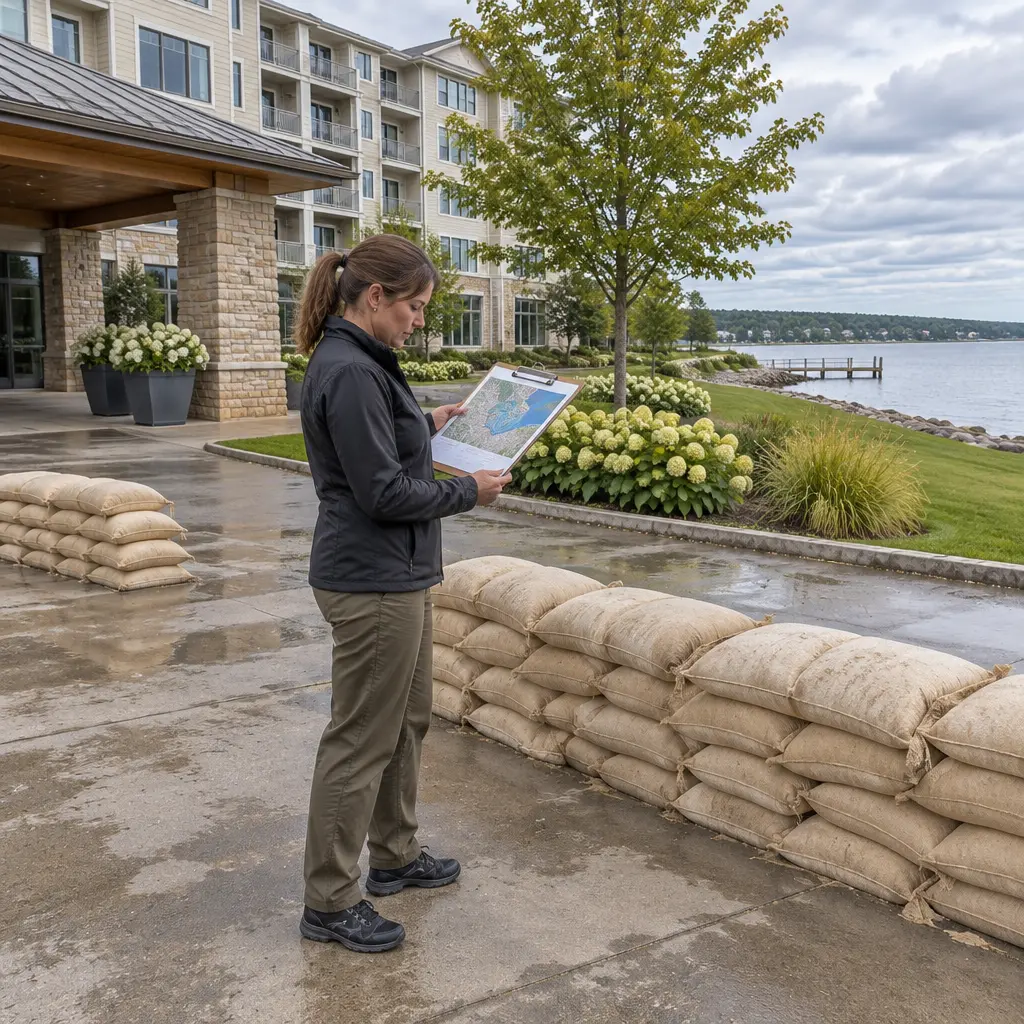
Waterfront hotel storm and flood preparedness is the coordinated work of protecting guests, staff, buildings, and essential services from severe weather and coastal or river flooding—and deciding when to restrict operations or close. Hotels do this through hazard planning, warnings and evacuation procedures, physical flood protection, continuity plans, and carefully managed reopening. The stakes are substantial: the U.S. National Oceanic and Atmospheric Administration (NOAA) reported 27 U.S. weather and climate disasters causing at least $1 billion in damage each during 2024, while the Federal Emergency Management Agency (FEMA) notes that just one inch of floodwater can cause roughly $25,000 in damage to a typical home. Hotel losses vary, but those figures show why waterfront properties plan for both life safety and costly operational disruption.
How Waterfront Hotels Manage Storm and Flood Risk
A waterfront hotel is a lodging property situated beside or near a coastline, river, lake, harbor, or other water body, where exposure may include storm surge, coastal or river flooding, erosion, high winds, and interrupted transport or utilities. There is no single universal hotel standard for storm response; plans are shaped by local emergency-management rules, building codes, site conditions, and the property’s own risk assessment. FEMA’s National Risk Index and NOAA’s flood and coastal-hazard information help organizations understand location-specific threats, but hotel operators must translate hazard data into practical decisions for their guests and facilities.
The central operating principle is to protect people first, then limit damage and restore critical services. A sound plan sets clear triggers for monitoring, sheltering, evacuation, service suspension, and reopening; identifies who has authority to make each decision; and provides accessible communication for guests with different language, mobility, and medical needs. The following sections explain how hotels assess hazards, prepare buildings and teams, manage closures, and reopen responsibly.
Assessing Waterfront Hotel Storm and Flood Exposure
Storm and flood exposure is the likelihood that a hazard will affect a particular site, combined with the potential consequences for people, property, and operations. The U.S. Geological Survey (USGS) describes flooding as the temporary inundation of land that is normally dry; for hotels, the practical risk assessment must also consider how water reaches the site, how deep and fast it may be, and whether access or essential systems fail even when the main building remains dry.
Coastal surge, waves, and high winds
Storm surge is an abnormal rise of water generated by a storm, above the predicted astronomical tide. NOAA explains that surge, waves, tides, and rainfall can combine to make coastal flooding especially dangerous. A hotel may therefore face flooding from the seaward side, wind-driven waves, debris impacts, and roof or façade damage in the same event. Operators should review local evacuation zones, surge forecasts, elevation, shoreline conditions, and the vulnerability of lower floors, parking areas, generators, and electrical equipment.
River, rainfall, and compound flooding
River flooding occurs when water overtops a channel or bank, while pluvial flooding results when intense rainfall overwhelms drainage or accumulates in low-lying areas. A waterfront property can experience compound flooding when heavy rain, high river levels, tides, and storm surge coincide. Flood maps are useful screening tools, but they do not represent every possible event or guarantee that land outside a mapped high-risk zone is safe. Hotels should combine mapping with site drainage reviews, flood history, local warning procedures, and advice from engineers and emergency-management officials.
Risk assessment and critical dependencies
A hotel risk assessment connects hazards to specific people, assets, and services. It should identify where water could enter, which floors and routes are vulnerable, and how the loss of power, potable water, wastewater service, communications, roads, or staff access would affect operations. FEMA’s National Risk Index offers county- and census-tract-level hazard information, while the National Flood Insurance Program’s maps help indicate mapped flood exposure. Neither replaces a property-level engineering assessment, particularly where sea-level rise, erosion, drainage limits, or recent development may alter conditions.
Once a hotel understands its likely hazards and dependencies, it can choose measures that reduce exposure before a warning arrives.
Preparing Hotel Buildings, Staff, and Guests
Preparedness is the set of advance actions that help a hotel protect people and maintain or recover essential functions during a hazard. It includes physical improvements, emergency procedures, staff training, supplies, and communication. FEMA’s Ready Business guidance encourages organizations to plan for continuity and to tailor procedures to local risks; hotels can apply that approach by integrating storm plans with their existing fire, medical, security, and business-continuity procedures.
Building protection and flood mitigation
Flood mitigation reduces the chance or severity of damage. Depending on site conditions and building regulations, measures may include elevating or relocating electrical and mechanical equipment, installing flood barriers or backflow valves, protecting openings, anchoring outdoor equipment, improving drainage, and using flood-resistant materials in areas expected to get wet. Hotels should not rely on temporary barriers as a substitute for evacuation when authorities advise leaving. FEMA’s flood guidance emphasizes that flood risk can exist beyond high-risk map zones, so owners should evaluate both the building and its access routes.
Emergency staffing, supplies, and guest communication
An emergency staffing plan assigns decision-making authority and practical duties across management, security, engineering, housekeeping, food service, and front-desk teams. It should cover shift handoffs, staff transportation, essential contact lists, backup communications, and the possibility that employees may be unable to report. Guest procedures should explain warning channels, evacuation routes, assembly points, accessible transport arrangements, and how guests can request assistance. Hotels can communicate through text alerts, room phones, public-address systems, printed notices, and staff briefings, with consistent updates across channels to reduce confusion.
Training and exercises
Training turns written plans into actions staff can perform under pressure. Tabletop exercises can test management decisions, while practical drills can test notifications, evacuation routes, equipment, and guest accountability. Exercises should include realistic complications such as a blocked road, power failure, limited staffing, or a guest requiring mobility assistance. After each exercise or real incident, managers should record lessons, assign corrective actions, and update plans rather than treating the exercise as a one-time compliance task.
Preparedness reduces avoidable harm, but it cannot eliminate the possibility that continuing to operate becomes unsafe. That is why hotels need defined closure and evacuation criteria before a storm is imminent.
Making Closure, Evacuation, and Shelter Decisions
A hotel closure is a temporary suspension of some or all services because operating conditions cannot be maintained safely or lawfully. Closure is distinct from evacuation: a hotel might stop accepting arrivals while guests remain temporarily sheltered, or it might evacuate everyone when authorities identify an unacceptable threat. Decisions should follow official orders and local emergency-management guidance, supported by pre-established internal triggers rather than improvised judgment alone.
Monitoring and decision triggers
Monitoring means tracking authoritative forecasts, warnings, road conditions, local emergency instructions, and the status of critical utilities. Hotels should designate who checks updates and how often, and should define thresholds for actions such as stopping check-ins, moving guests away from exposed areas, closing amenities, or beginning evacuation. Because a forecast changes and hazards can develop quickly, a plan should specify who can escalate a response without waiting for a full management meeting.
Evacuation versus sheltering in place
Evacuation moves guests and staff away from a hazard to a safer location; sheltering in place keeps people inside a building or designated refuge when travel is more dangerous or an evacuation is not ordered. The correct choice depends on the hazard, warning time, building design, official instructions, and the safety of evacuation routes. Hotels should never assume that upper floors are automatically a safe refuge for every flood or storm scenario. If authorities order evacuation, the property’s plan should support timely movement, accessible transport, guest accountability, and clear instructions about where to go.
Guest support, reservations, and business continuity
A closure plan also addresses people and obligations beyond the building. Hotels should have procedures for contacting guests with upcoming reservations, explaining cancellations or relocation options, preserving records, protecting personal information, and coordinating with travel partners. Business-continuity planning identifies essential functions, backup systems, alternate suppliers, and recovery priorities. The U.S. Small Business Administration advises businesses to plan for disruptions and protect records; for hotels, this can include secure backups of booking and payroll information, emergency vendor contacts, and a process for tracking expenses and damage after an event.
The operational value of a clear closure decision becomes most visible after landfall or peak flooding, when a property must verify safety before resuming service.
Inspecting Damage and Reopening Waterfront Hotels
Reopening is the controlled restoration of hotel operations after the immediate threat has passed. It should be based on verified safety, not simply the end of a warning or a clear-looking exterior. Floodwater can conceal electrical hazards, structural damage, contaminated materials, and damaged roads or utilities. The Centers for Disease Control and Prevention (CDC) advises people to avoid floodwater because it may contain sewage, chemicals, and other hazards; hotel teams should likewise keep guests and untrained staff out of affected areas until the site has been assessed.
Damage assessment and life-safety checks
Before reopening, qualified personnel should assess structural stability, electrical and gas systems, elevators, fire protection, potable water, wastewater, food storage, and emergency exits. The property should document damage with photographs and written records, preserve relevant insurance information, and follow instructions from building officials, utility providers, and public-health authorities. A building may need restricted access while engineers or specialist contractors evaluate damage; managers should communicate those restrictions clearly.
Cleaning, utilities, and phased return to service
Recovery work removes water and debris, dries affected spaces, cleans and disinfects surfaces, and replaces materials that cannot be safely restored. CDC guidance recommends appropriate protective equipment and caution during flood cleanup, particularly where mold, sewage, or electrical hazards may be present. Hotels should confirm that drinking water is safe, wastewater systems work, and critical equipment has been inspected before serving guests. A phased reopening—starting with verified-safe areas and essential services—can reduce risk while repairs continue, provided guests are told exactly which facilities are available.
Learning from past storms
Major coastal disasters show why recovery planning matters. Hurricane Katrina in 2005 and Hurricane Sandy in 2012 caused extensive damage and prolonged disruption across affected communities, including impacts to transport, utilities, and tourism businesses. The precise consequences for any one hotel depend on its location and construction, but these events demonstrate that recovery can extend well beyond the period of strongest winds or highest water. Post-event reviews should update flood maps and assumptions where appropriate, revise contact and supplier lists, and prioritize investments that address observed weaknesses.
Conclusion: Safer, More Resilient Waterfront Hotel Operations
Waterfront hotel storm and flood management begins with assessing coastal, river, rainfall, and compound hazards; continues through building mitigation, staff training, and guest communication; and depends on timely closure or evacuation decisions when conditions become unsafe. Reopening then requires documented inspections, safe utilities, careful cleanup, and a phased return where necessary. NOAA’s record of 27 U.S. billion-dollar weather and climate disasters in 2024 underscores the broader relevance of preparation, while flood-safety guidance from FEMA and the CDC shows why water-related hazards demand both prevention and caution.
Hotel owners and managers can take a practical next step by reviewing their local hazard information, confirming evacuation and shelter procedures with emergency authorities, and testing their continuity plan with staff. Guests can also check official alerts, understand a property’s emergency instructions, and follow evacuation orders promptly. These actions help protect lives while strengthening the resilience of tourism businesses and waterfront communities.
Sources: National Oceanic and Atmospheric Administration, Billion-Dollar Weather and Climate Disasters, https://www.ncei.noaa.gov/access/billions/; Federal Emergency Management Agency, Flood Insurance and Flood Risk Information, https://www.floodsmart.gov/flooding; Federal Emergency Management Agency, National Risk Index, https://hazards.fema.gov/nri/; Federal Emergency Management Agency, Ready Business, https://www.ready.gov/business; National Oceanic and Atmospheric Administration, Storm Surge Overview, https://oceanservice.noaa.gov/facts/stormsurge-stormtide.html; U.S. Geological Survey, Floods: Things to Know, https://www.usgs.gov/special-topics/water-science-school/science/floods-things-know; U.S. Small Business Administration, Prepare for Emergencies, https://www.sba.gov/business-guide/manage-your-business/prepare-emergencies; Centers for Disease Control and Prevention, Safety Guidelines: Floodwater, https://www.cdc.gov/floods/safety/index.html; Centers for Disease Control and Prevention, Cleaning Up After a Flood, https://www.cdc.gov/floods/cleanup/index.html.